0086-379-64086155
*An industry-wide introduction to mining and mineral processing, written for the official website.*
Beneath the roads we drive on, the buildings we live in, and the devices we carry every day lies an industry that rarely appears in the spotlight yet supports almost everything around us — mining. From the steel in our bridges to the copper in our cables, from the aluminum in our aircraft to the lithium in our batteries, virtually every manufactured product begins as ore extracted from the earth. Mining is not merely the extraction of rock; it is the starting point of the entire industrial chain that defines modern life.
Few industries can claim such broad influence. Mining provides the raw materials for construction, energy, transportation, electronics, agriculture, and medicine. It creates jobs in remote regions, contributes to national treasuries through taxes and royalties, and feeds a vast ecosystem of downstream manufacturers. When the mining industry prospers, the effects ripple through economies and communities far beyond the mine gate.
To understand the mining industry, it helps to follow the journey of a single piece of ore from the ground to a finished product. The story begins at the mine site, where ore is recovered either from open-pit operations — large terraced excavations used when mineral deposits lie close to the surface — or from underground mines, which follow deeper veins and seams through tunnels and shafts.
Once the ore is brought to the surface, the real work of mineral processing begins. The goal of this stage is to separate the valuable minerals from the worthless rock, or gangue, so that the metal-bearing concentrate can be passed on to smelters and refineries. A typical processing flowsheet moves through several well-defined stages:
· Crushing reduces the blasted rock into smaller fragments, preparing it for further size reduction.
· Grinding (milling) further reduces the ore into fine particles, liberating the valuable mineral grains from the surrounding rock.
· Classification sorts the particles by size, returning oversized material for further grinding and passing the fine material onward.
· Separation — often by flotation, gravity, or magnetic methods — isolates the valuable minerals from the rest of the slurry.
· Dewatering and tailings management concentrate the final product while storing the waste rock responsibly.
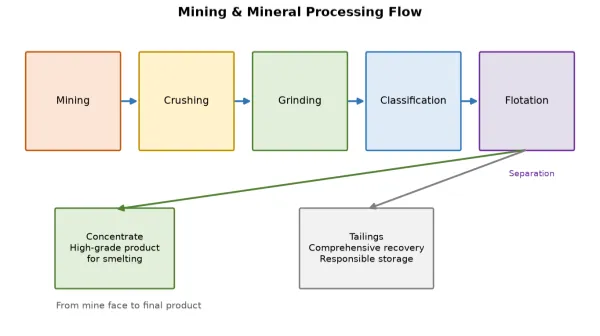
The figure above summarizes the full flow from mining through crushing, grinding, classification, and flotation, ending in a high-grade concentrate for downstream smelting, together with responsibly managed tailings.
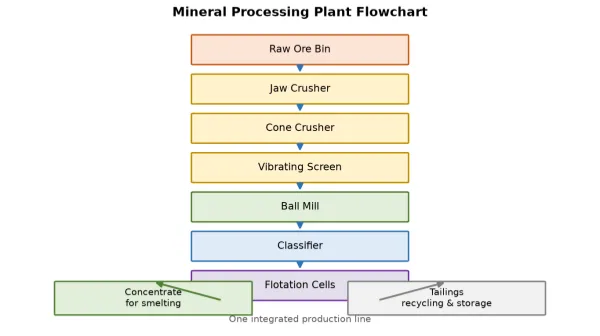
A mineral processing plant is essentially a chain of such stages operating as one integrated system. Ore enters one end of the plant and emerges at the other as concentrate, with each unit operation carefully sized and tuned to the characteristics of the ore being treated.
No discussion of the mining industry would be complete without acknowledging the machines that keep it running. These are best understood not as standalone products, but as components of an integrated industry — links in a continuous chain that turns rock into value.
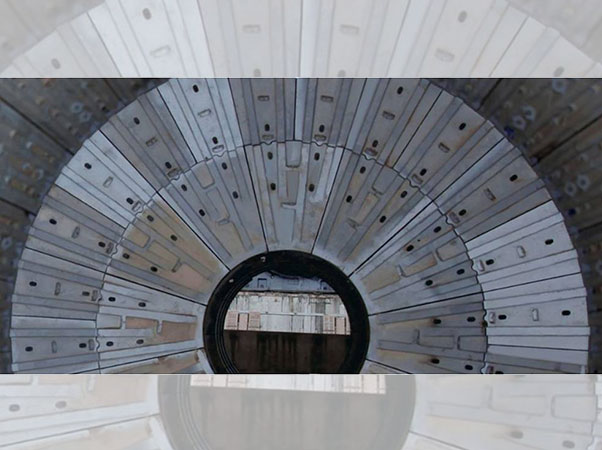
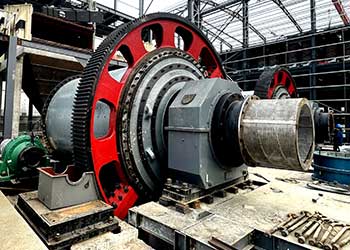
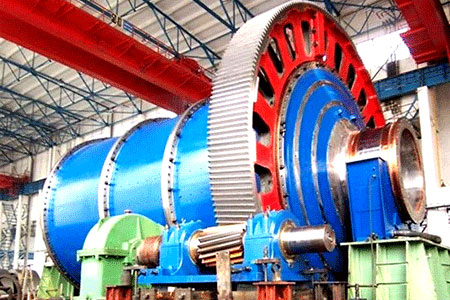
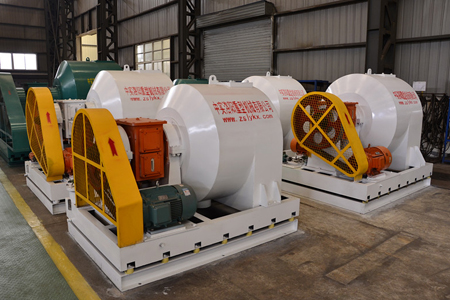
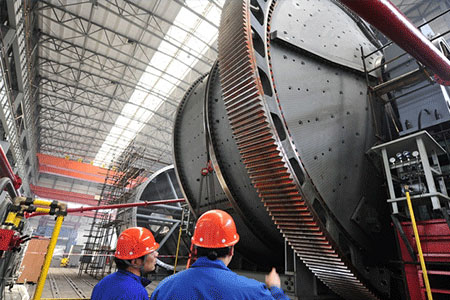
Among the most recognizable pieces of equipment is the ball mill, which performs the grinding stage at the heart of nearly every processing plant. Inside a rotating drum, steel balls tumble against the ore, crushing and grinding it into fine powder. The particle size produced here directly determines how effectively the downstream separation stages can recover the valuable minerals.
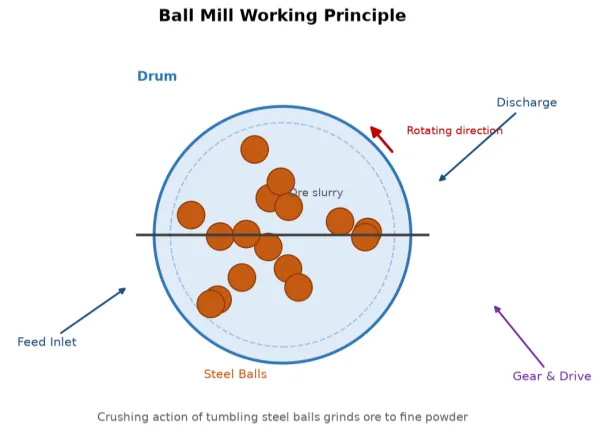
Around the ball mill stands a family of supporting machines: crushers reduce run-of-mine ore at the head of the circuit; classifiers control particle size between stages; and flotation cells, which use air bubbles to selectively collect mineral particles in a water-based slurry, are the workhorses of modern ore separation. Together these machines form a coordinated circuit in which each step builds on the previous one — a living illustration of how equipment serves the industry rather than standing apart from it.
The efficiency of this equipment matters enormously. Small improvements in grinding energy use, separation recovery, or water consumption translate into meaningful gains in cost, resource utilization, and environmental performance across the entire industry.
The significance of mining reaches far beyond the mine site. Mineral products are fundamental to national economies: they underpin infrastructure, enable industrialization, and sustain manufacturing supply chains. Steel, aluminum, copper, and a growing list of critical minerals such as lithium, cobalt, and rare earth elements are essential to the energy transition — the very wind turbines, solar panels, and electric vehicles that promise a lower-carbon future all depend on reliable mineral supply.
Mining also plays a vital social role. It provides direct and indirect employment, supports local communities through infrastructure and services, and drives economic development in regions that may have few other opportunities. A well-managed mining industry can be a powerful engine of prosperity and progress.
Like every major industry, mining is being reshaped by the global push for sustainability. Modern operations increasingly adopt energy-efficient equipment, recycle process water, and recover value from tailings that were once discarded. Land is progressively reclaimed and rehabilitated after mining, and communities are engaged as partners rather than bystanders.
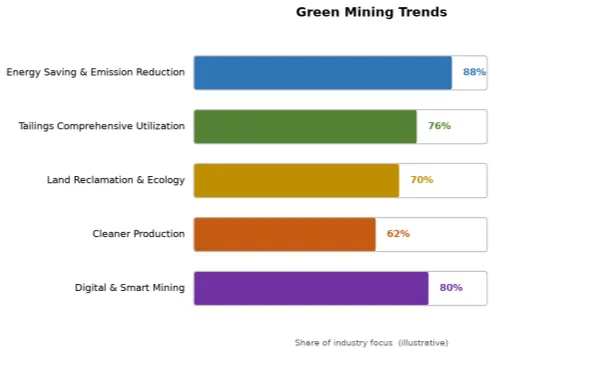
The figure above highlights the key directions of today's green mining agenda: energy saving and emission reduction, comprehensive utilization of tailings, land reclamation and ecological restoration, cleaner production with stricter environmental standards, and the adoption of digital and smart technologies for more precise and efficient operation.
Green mining is not a departure from the industry's purpose; it is the industry maturing. By producing more with less — less energy, less water, less waste — modern mining is learning to supply the materials the world needs while protecting the planet it draws them from.
The mining industry is the quiet foundation of modern civilization — a vast, complex, and increasingly sophisticated sector that turns the earth's resources into the goods that shape our daily lives. From open-pit benches to underground tunnels, from the rumble of crushers to the precise control of flotation circuits, every stage of the journey reflects the same purpose: transforming raw ore into value, responsibly and sustainably.
Understanding the industry as a whole — its processes, its equipment, and its place in the world — reveals why mining deserves attention far beyond the mine gate. It is an industry at the very beginning of every supply chain, and its future is inseparable from our own.


Contact Us
 English
  日本語
日本語  français
  Deutsch
  Español
  italiano
  русский
  português
  العربية
  română
  Nederland


 日本語
日本語